
The Truth About Putting Hot Dishes on Your Countertops (Hint: Don’t Do It)
One of the most common questions we hear from homeowners is:
“Can I put a hot pan directly on my countertop?”
The answer surprises a lot of people.
No. You shouldn’t.
Not on quartz.
Not on granite.
Not on marble.
Not on quartzite.
Not on any countertop surface.
Now before someone says, “But granite is heat resistant!” let’s talk about the difference between being heat resistant and being heat proof.
Because they are not the same thing.
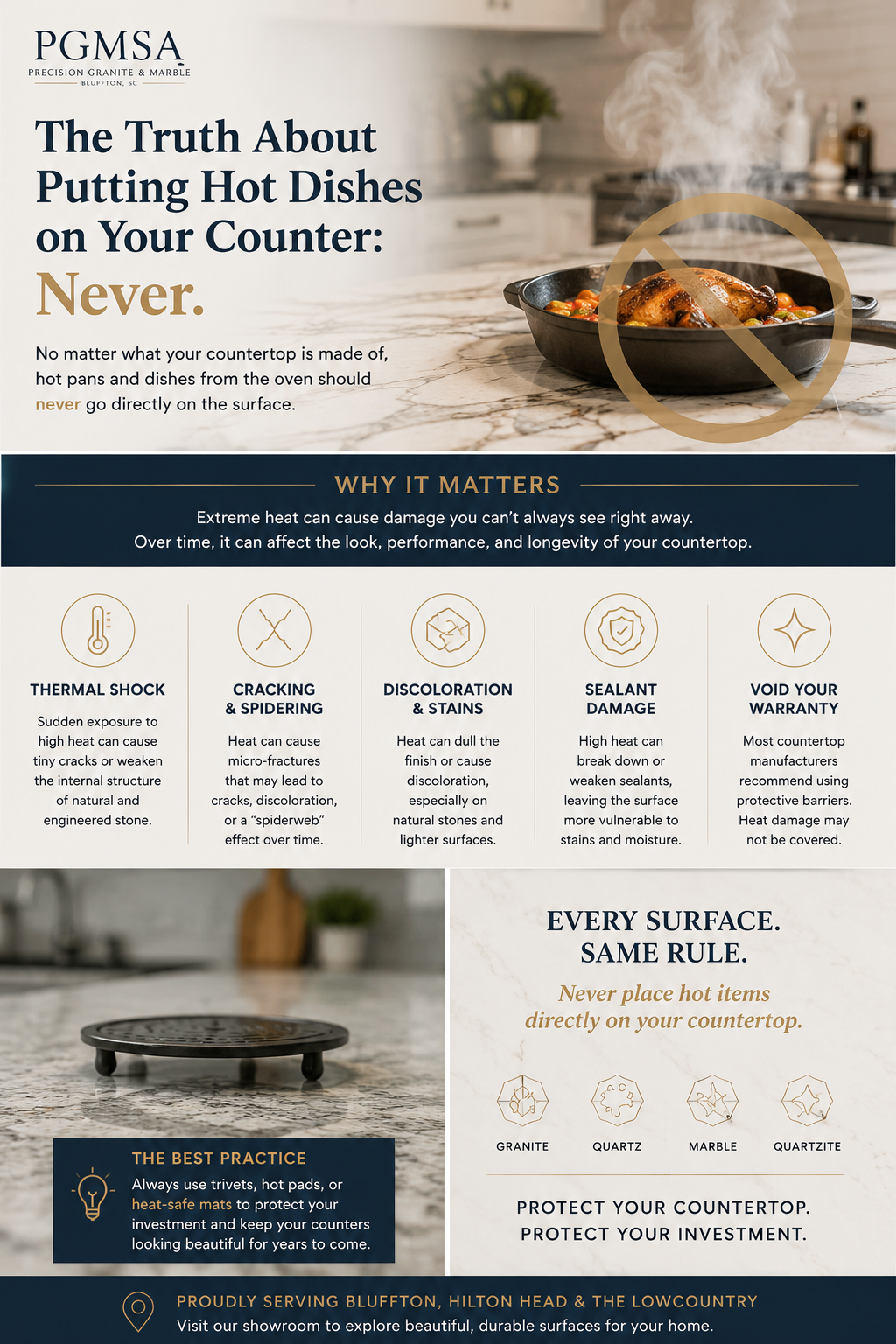
Heat Resistant Doesn’t Mean Heat Proof
Many natural stones can tolerate heat better than most people realize.
Granite, quartzite, and some other natural stones are formed under tremendous heat and pressure inside the earth.
That doesn’t mean your finished countertop is indestructible.
When a hot pan comes directly out of a 400°–500° oven, you’re introducing intense, concentrated heat to a very specific area of the surface.
Over time, that can create problems.
And some of those problems aren’t immediately visible.
The Problem Isn’t Always the Stone
Many homeowners focus on the countertop material itself.
But the stone is only one part of the equation.
Your countertop system may also include:
Sealers
Adhesives
Epoxies
Support materials
Fabricated seams
These components can react differently to heat than the stone itself.
In many cases, it’s not the granite or quartz that’s damaged first—it’s the materials used to fabricate and install it.
What Can Happen When You Put Hot Pans on Countertops?
While damage doesn’t happen every time, repeated exposure to extreme heat increases the risk.
Potential issues include:
Thermal Shock!
When one section of a countertop heats rapidly while surrounding areas remain cooler, stress can develop within the material.
Over time this can contribute to:
small fractures
weakened areas
surface stress
It’s Not Just Your Countertop—Glass Bakeware Can Break Too
Most people worry about what a hot pan might do to their countertop.
But sometimes the countertop isn’t the thing at risk.
Glass bakeware can also be damaged when it experiences a sudden temperature change.
For example:
Taking a glass baking dish directly from a hot oven and placing it on a cold countertop
Setting hot glass cookware on a wet surface
Moving a hot dish from the oven to a cold sink
Placing hot glass on a stone countertop that is significantly cooler than the dish
This rapid temperature change is called thermal shock.
When different parts of the glass cool at different rates, stress can build within the material. In some cases, the dish may crack immediately. In others, microscopic damage can occur that weakens the glass and leads to breakage later.
That’s why manufacturers of glass bakeware often recommend placing hot dishes on:
Trivets
Cooling racks
Dry towels
Hot pads
rather than directly onto cold surfaces.
The same habit that helps protect your countertops can also help protect your cookware.
A Simple Rule to Remember
If it just came out of the oven, give it a safe place to land.
Whether you’re protecting:
your quartz countertops
your granite countertops
your marble surfaces
your quartzite island
or your favorite glass baking dish
a trivet is always the safer choice.
Damage to Sealers
Natural stone countertops are often sealed to help resist staining.
Excessive heat can break down those sealers faster, leaving the surface more vulnerable to:
moisture
oils
staining
Discoloration
Heat exposure can sometimes affect:
resins
sealers
lighter-colored materials
This may appear as:
dull spots
discoloration
changes in finish
Quartz Is Especially Vulnerable
Quartz countertops contain natural quartz particles combined with resins and binders.
While quartz is incredibly durable, those resins can be affected by extreme heat.
Manufacturers commonly recommend avoiding direct contact with:
hot pans
baking sheets
slow cookers
electric griddles
Ignoring those recommendations may even impact warranty coverage.
What About Granite?
Granite is often considered one of the most heat-resistant countertop materials available.
And that’s true.
If someone asked which material handles heat better, granite would likely rank near the top.
But even then, countertop professionals still recommend using trivets and hot pads.
Why?
Because the risk simply isn’t worth it.
A trivet costs a few dollars.
A countertop repair can cost hundreds—or more.
What About Quartzite?
Quartzite is another natural stone known for excellent heat resistance.
Many homeowners choose quartzite because it combines:
natural beauty
durability
strong heat performance
Even so, we still recommend treating it the same way we treat every countertop material:
Use protection whenever something comes directly from the oven or stovetop.
The Best Habit You Can Build
The easiest solution is also the simplest.
Keep a few:
trivets
hot pads
heat-safe mats
within easy reach of your cooking area.
After a few weeks, it becomes second nature.
And you’ll never have to wonder whether a pan was too hot.
Our Rule at Precision Granite & Marble
People often ask us:
“What’s the safest countertop for hot pans?”
Our answer is always the same:
No countertop is safer than a trivet.
Whether you have:
granite
quartz
quartzite
marble
the best practice is exactly the same.
Protect the surface.
Protect your investment.
And avoid taking unnecessary risks with something you’ll use every day.
Final Thoughts
Granite, quartzite, marble, and quartz are all durable materials. But durability doesn’t mean invincible.
Hot pans, baking dishes, cast iron skillets, and Dutch ovens should never be placed directly on your countertops.
Using a trivet takes seconds and can help preserve the beauty and performance of your countertops for years to come.
Visit Our Bluffton Showroom
Have questions about countertop care, maintenance, or choosing the right material for your home?
Visit our Bluffton showroom and talk with our team about the best options for your kitchen and lifestyle.
