
Mitered Edge vs. Waterfall Edge: What’s the Difference?
If you’ve been looking at kitchen inspiration lately, you’ve probably seen both mitered edges and waterfall islands come up over and over again.
They’re two of the most popular design details in modern kitchens right now, and while they’re often grouped together, they’re not the same thing.
One changes the look of the countertop edge.
The other changes the look of the entire island.
And depending on your kitchen, one may make a lot more sense than the other.
What Is a Mitered Edge?
A mitered edge is a way of fabricating the countertop so it looks thicker than the slab actually is.
Instead of seeing the standard edge of the stone, the material is cut and joined at an angle to create the appearance of a thicker, more substantial profile.
It’s a detail that gives the countertop a cleaner, heavier look without needing an oversized slab.
You’ll usually see mitered edges used in kitchens that lean:
modern
clean-lined
slightly more architectural
It’s especially common with quartz, where homeowners want a thicker profile without the visual weight of a more decorative edge.
What Is a Waterfall Edge?

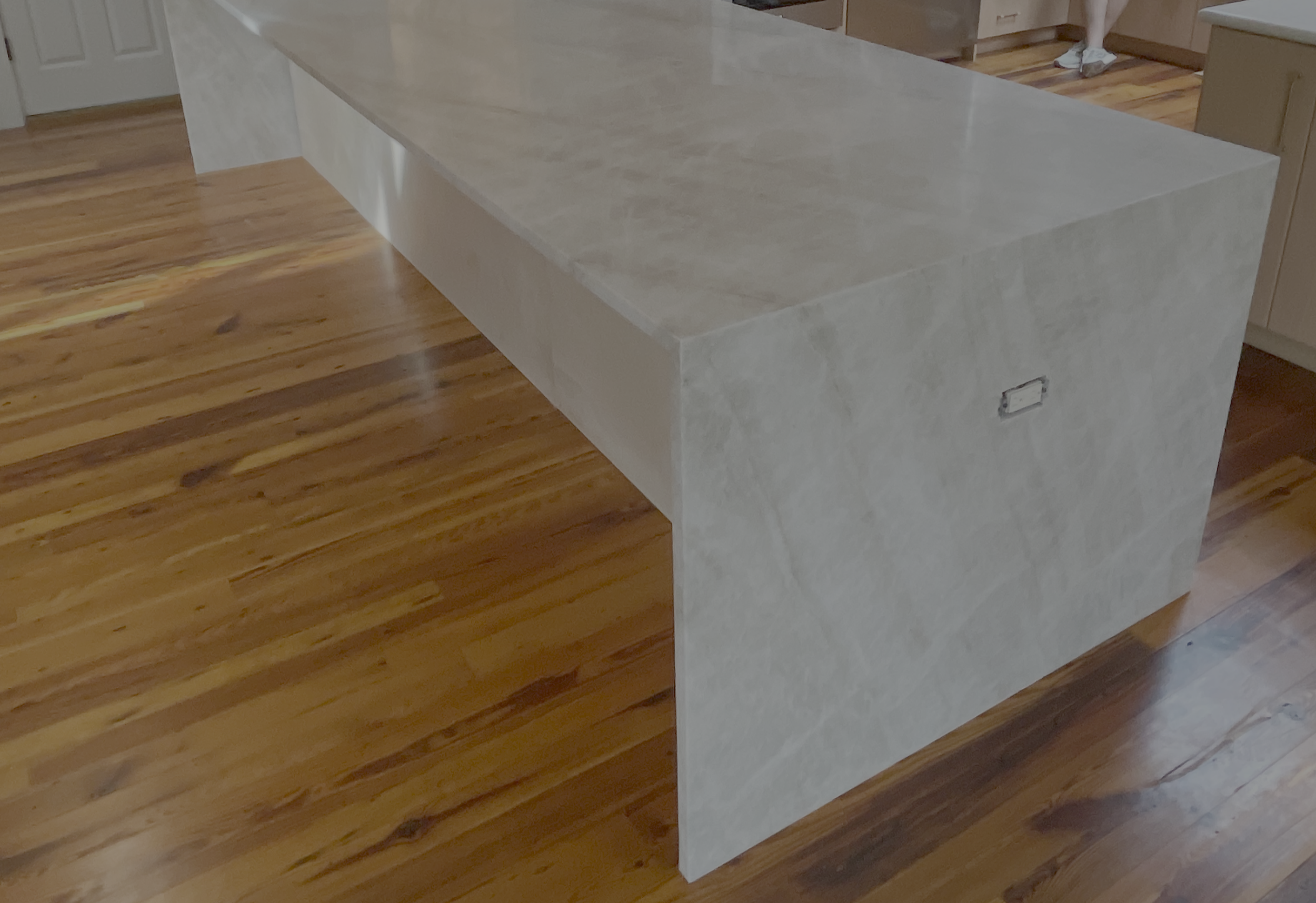
A waterfall edge is when the countertop continues down the side of the island to the floor.
Rather than stopping at the edge of the cabinet, the stone drops vertically, creating a more finished and dramatic look.
This is usually done on kitchen islands and is often used to make the island feel more custom and more intentional.
A waterfall edge tends to stand out more than a mitered edge. It draws your eye immediately and usually becomes one of the first things people notice in the kitchen.
The Difference Comes Down to Where the Detail Happens
This is the simplest way to think about it:
A mitered edge changes the profile of the countertop.
A waterfall edge changes the shape of the island.
That’s really the biggest difference.
A mitered edge affects how thick the countertop looks.
A waterfall edge affects how the island feels in the room.
They can be used separately, or they can be paired together—which is often what you’ll see in higher-end kitchens.
Which One Costs More?
In most cases, a waterfall edge will cost more.
That’s because it typically requires:
more material
more planning
more fabrication
more labor during installation
A waterfall panel usually means using more of the slab, especially if the veining needs to continue cleanly from the top down the side.
That kind of planning matters, especially with quartz, quartzite, or anything with noticeable movement.
A mitered edge can also increase cost, but usually not to the same degree. It adds fabrication time, but it doesn’t usually require the same amount of extra material a waterfall edge does.
Which One Makes More Sense?
That depends on what you want the kitchen to do.
If you want the island to feel more substantial, a mitered edge usually gets you there.
If you want the island to feel like a focal point, a waterfall edge usually does more.
A mitered edge is often the better fit when:
you want a thicker, cleaner look
you prefer something more subtle
you like modern design but don’t want the island to dominate the room
A waterfall edge usually makes more sense when:
the island is the visual centerpiece
the slab has strong veining worth showing off
the kitchen has enough space to support a bolder feature
What Are Most Homeowners Choosing Right Now?
It really depends on the kitchen.
In Bluffton and Hilton Head, we see mitered edges used more often in kitchens that lean clean, bright, and modern.
Waterfall edges tend to show up more in larger kitchens where the island has room to become more of a statement piece.
Both are popular. They just do different things.
Final Thoughts
Mitered edges and waterfall edges are often talked about together, but they solve for different design goals.
A mitered edge changes the look of the countertop.
A waterfall edge changes the look of the island.
Neither is automatically better. It really comes down to the layout, the material, and how much visual weight you want the stone to carry in the room.
If you’re deciding between the two, it’s much easier to compare them in person than it is in photos.
Visit Our Bluffton Showroom
If you’re comparing edge profiles for your kitchen, stop by our Bluffton showroom to see the difference in person and talk through what makes the most sense for your space.
